

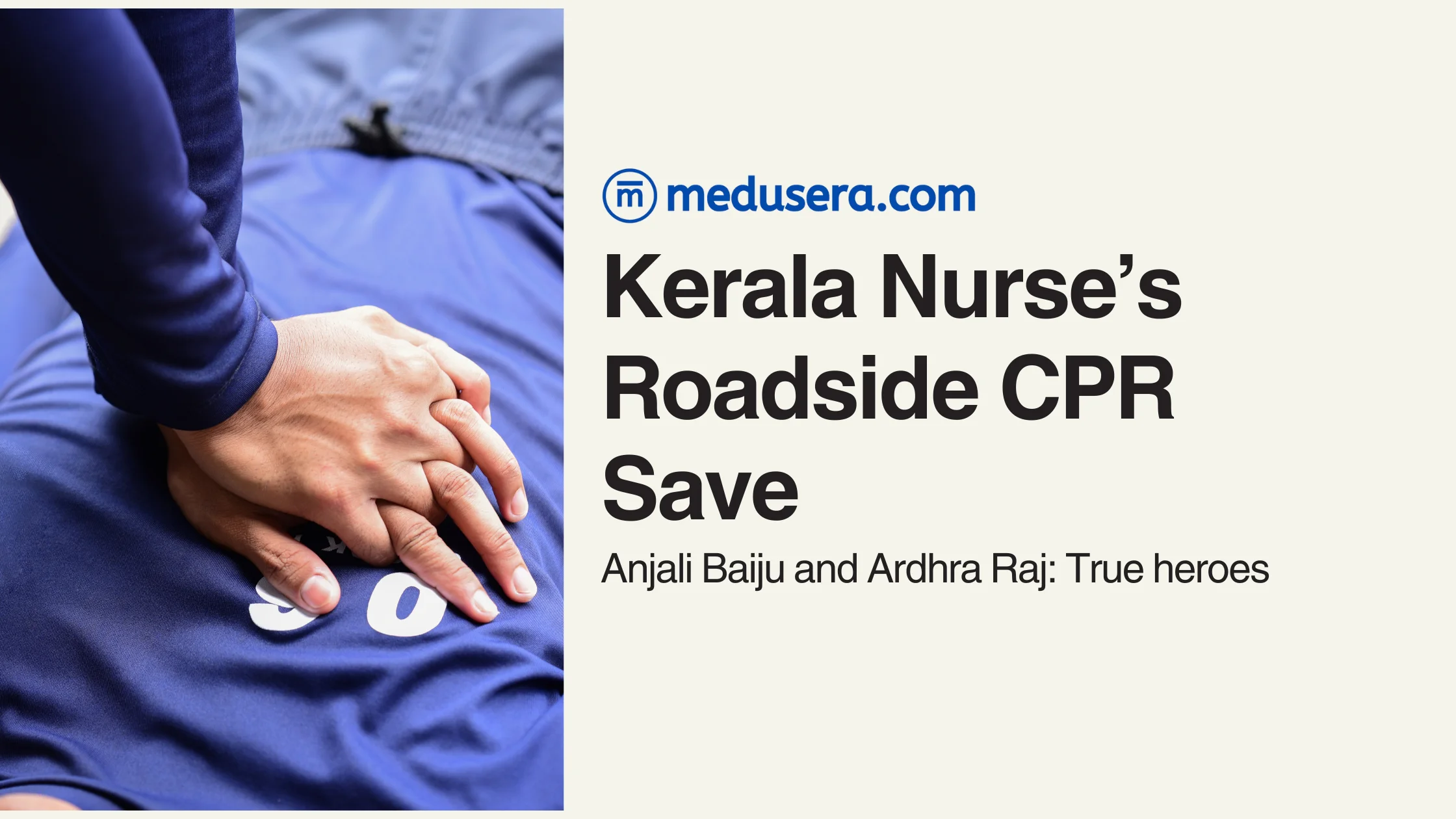
On a stretch of road near the Kalady bridge in Ernakulam, traffic had ground to a halt. Inside a car trapped in that jam, a 43-year-old lottery shop owner named Sinoj was having a heart attack, alone, with no one around him trained to help. Then two women got off a passing KSRTC bus.
What Happened Near Kalady Bridge
Anjali Baiju, a nurse at LF Hospital in Angamaly, and Ardhra Raj, a nursing student from Bengaluru, were travelling on the same road when they noticed a crowd forming around a stalled car. They stepped off the bus, reached the vehicle, and found Sinoj unresponsive with chest pain. Without waiting for an ambulance, they began CPR right there in the car.
What happened next is the part nursing students preparing for government exams should pay close attention to. The two nurses did not stop. They continued chest compressions while a bystander took over driving, while others in the crowd cleared a path through the jam, and while the car made its way to a hospital in Angamaly. By the time Sinoj reached the hospital, he had started showing signs of recovery. Doctors later found a blocked coronary artery and performed emergency angioplasty. He is expected to be moved to a higher centre for further treatment.
No defibrillator. No monitor. No hospital bed. Just two trained nurses who knew exactly what to do and did not hesitate to do it.
Why This Case Matters for Every Nursing Student
Every year, thousands of GNM and BSc Nursing graduates sit for NORCET, AIIMS Nursing Officer recruitment, RRB, ESIC, and state PSC nursing exams. A large share of the clinical and emergency nursing section in these exams draws directly from Basic Life Support and CPR protocols, precisely the skills that just saved a man’s life on a Kerala highway.
This is not abstract exam theory. It is what separates a nurse who freezes in an emergency from one who acts within seconds. If you are preparing for a nursing recruitment exam right now, this incident is a reminder that these questions are not there to test your memory. They are there to test whether you can be trusted with a life when there is no doctor, no equipment, and no time to think twice.
The BLS Protocol Every Nurse Must Know Cold
Basic Life Support follows a fixed sequence. Nursing exams love to test this sequence out of order, so knowing it cold matters more than knowing it approximately.
Step 1: Check Responsiveness and Call for Help
Tap the person and shout to check for a response. If there is none, call for emergency help or ask a bystander to do so immediately. In an exam setting, this is almost always the first correct action in a scenario-based CPR question.
Step 2: Check Pulse and Breathing
Check the carotid pulse for no more than 10 seconds while simultaneously looking for normal breathing. Absence of pulse or only gasping breaths confirms cardiac arrest.
Step 3: Start Chest Compressions
Place the heel of one hand on the centre of the chest, interlock the other hand on top, and compress at a depth of at least 5 cm (but not more than 6 cm) at a rate of 100 to 120 compressions per minute. Full chest recoil between compressions is essential and is a frequently tested detail.
Step 4: Rescue Breaths and Compression Ratio
For a single rescuer, the standard compression to ventilation ratio is 30:2. This ratio is one of the most commonly asked numerical facts in nursing recruitment exams, so it is worth memorising precisely rather than approximately.
Step 5: AED Use When Available
As soon as an Automated External Defibrillator is available, it should be applied and used according to its voice prompts, without stopping compressions for longer than necessary.
The Chain of Survival, Explained
The American Heart Association’s Chain of Survival links five actions: early recognition and activation of emergency response, early CPR, rapid defibrillation, basic and advanced emergency medical services, and post-cardiac arrest care. In Sinoj’s case, the first two links, recognition and early CPR, were completed almost perfectly by two off-duty nurses who happened to be on the same bus at the right moment. That is the entire point of training every nursing graduate to this standard: readiness cannot depend on luck.
Common CPR and BLS Questions in NORCET and AIIMS Nursing Officer Exams
Based on recurring patterns in previous exams, expect questions built around these areas:
- The correct compression to ventilation ratio for single-rescuer adult CPR
- Correct hand placement and compression depth
- The order of steps in the BLS algorithm
- Signs that indicate cardiac arrest versus fainting
- When to use an AED and how it fits into the compression cycle
- The five links of the Chain of Survival, in order
FAQs on CPR for Nursing Exam Preparation
What is the correct compression rate for adult CPR?
The correct rate is 100 to 120 chest compressions per minute, with a depth of 5 to 6 cm and full chest recoil between compressions.
What is the compression-to-ventilation ratio for a single rescuer?
For a single rescuer performing CPR on an adult, the ratio is 30 compressions to 2 rescue breaths.
Why do nursing exams focus so heavily on CPR and BLS?
Because these are the skills a nurse is most likely to need in a genuine emergency, whether in a hospital corridor or, as this incident shows, on a public road.
To watch the complete guide to CPR in Hindi : https://medusera.com/videos-library/complete-cpr-in-hindi-for-beginners-freshers-medical-and-nursing-students-in-40-minutes/


